
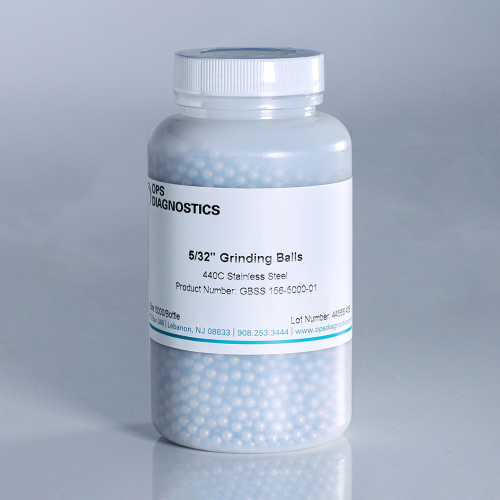
Grinding Balls, 5/32", 440C Stainless Steel, Bottle of 5000
- OPS Diagnostics
- GBSS 156-5000-01
- Na skladě
-
16 692,50Kč
OPS Diagnostics 5/32” stainless steel grinding balls are used for the homogenization of a broad array of samples. In plant pathology, the grinding balls have been used to measure Aspergillus biomass in maize(Mideros et al., 2009), map leaf blight resistance in maize (Chung et al., 2010), and Monitoring of Botrytis cinerea infection of grapes (Cadle-Davidson, 2008). In plant breeding, balls were used for the analysis of Quantitative Trait Loci associated with nematode pathogen susceptibility in Soybean (Wilkes et al., 2020), and for NGS of plant immunity Plant Pattern Recognition Receptors in Arabidopsis thaliana (Fan et al., 217). With invasive species, grinding balls were used for the analysis of microbes and invertebrates of Phragmites australis (Kennedy, 2008).
SUGGESTED PROTOCOL
Homogenization of plant samples is best accomplished if the tissue is dry or with buffer. Fresh tissue will often stick to the sides of tube/well and not grind effectively. Grinding balls can be used with deep well plates (round or square), 2 ml disruption tubes, or any plastic vial that will fit in a homogenizer.
- Place plant sample in the tube or well. Generally, the mass of sample can be:
- Deep well plate – 50 mg fresh tissue with buffer, or 150 mg dry tissue with no buffer.
- 2 ml Disruption tube – 50 mg fresh tissue such as leaf punches, or 150 mg dry tissue for grinding without buffer.
- 5 ml PC vials or screw cap tubes – 150 mg fresh tissue with buffer or 500 mg dry tissue for dry grinding.
- Drop in one grinding ball for deep well plates and disruption tubes. Up to 3 to 5 grinding balls can be used for larger tubes.
- If buffer is added, add approximately ¼ volume of the tube, e.g., 500 µl for a 2 ml tube.
- Place the plate/tubes in a homogenizer and process for 1-3 minutes.
- The length of processing will be dependent upon the resilience of the sample and the speed of the homogenizer. Stainless steel grinding balls can be removed from the sample tube using a Magnet Tip or by dragging a magnet up the side of the tube. For deep well plates, the magnet must be inserted into the well. Depending upon the objective, centrifuging the supernatant will yield a relatively clear lysate containing analytes. Alternatively, the pellet will contain insoluble biomass.